Ephemeral sketch

You May Get There Despite Everything
How can a man walk into a wheat field, press a gun to his chest, pull the trigger, and linger between life and death for two days, dying at thirty-seven? Ten years of creation lie behind him, years in which he created all that he would leave us. Yet when he pulls the trigger, none of it is enough. He enters the wheat field, seeing himself as a failure. He believes he has no future, no hope. He will never sell his work. He is a burden to his brother, Theo. And everything, he is certain, will only grow worse.
Meeting him at this moment reminds us of how destructive self-image, despair, rejection, and failure can be, even for someone with great talent. You sing your song as beautifully as you can, but all you hear are broken, faltering croaks.
Even when he was willing to acknowledge some talent, it was so minimized and constrained: “All I have to contribute is my ability to work with colors,” he wrote to his brother.
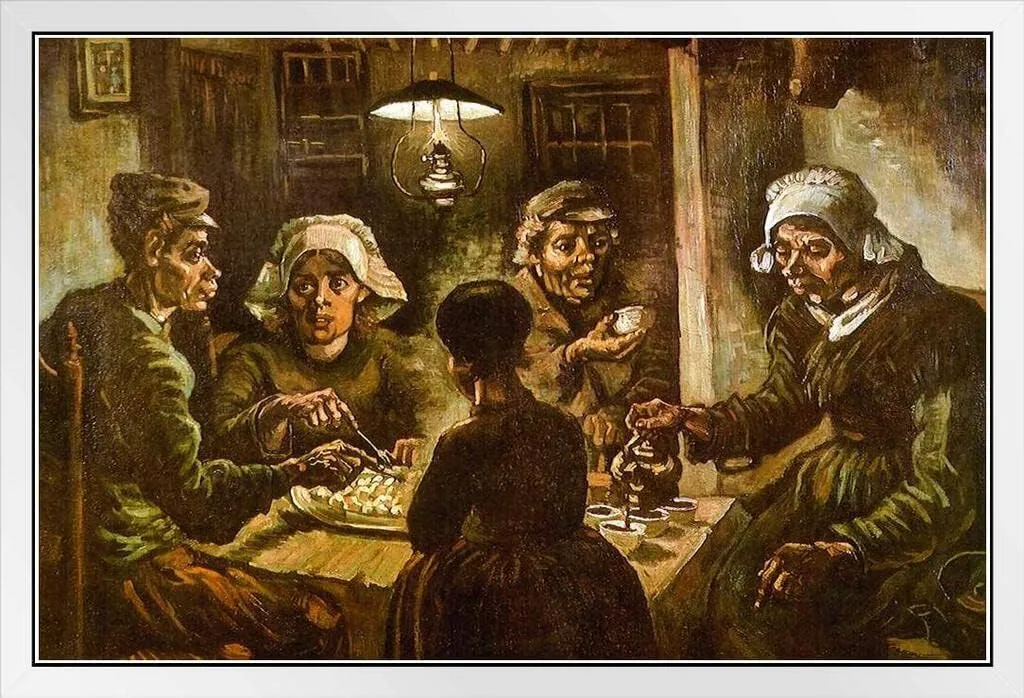
Five years after deciding to pursue painting, fueled by the same passion he once had for serving God—believing he might become a priest – he commits himself to creating a masterpiece. He starts by painting heads and learns to paint portraits. The figures are shown eating potatoes. He titles the work “The Potato Eaters,” depicting five figures around a table, worn out from a hard day’s work in the fields. “The hands that dug up the potatoes are the same hands now eating them,” he writes to his brother. To him, the peasants’ most important qualities are their simplicity, harmony with nature, and honest labor, reflected in their sweat and effort to earn their food.
I was amused by the idea that even in the late 1800s, people longed to reconnect with nature and escape the industrialized, “civilized urban world.” For him, peasants embodied this yearning.
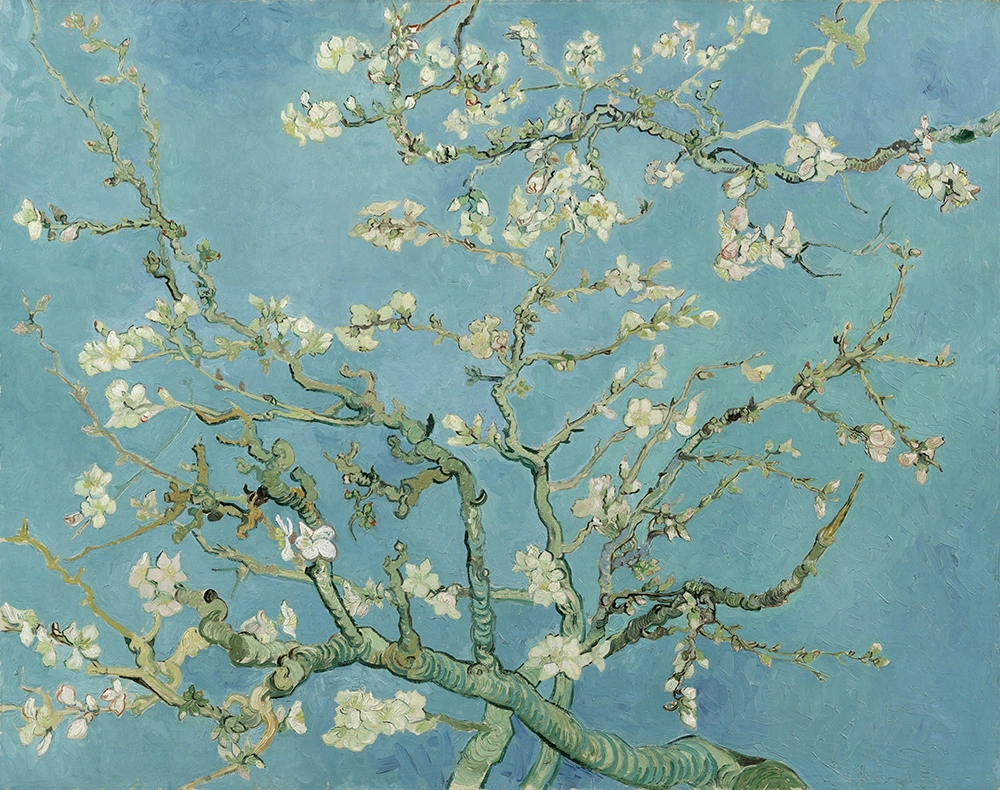
From him, I learned that the subject is equally important. It is never incidental. You do not randomly place a peasant, sunflowers, or a flowering almond tree before your brush. Take, for example, the flowering almond he painted the year he shot himself, that vivid force that longed to live, that yearned so deeply for blossoming.
I had always been aware of the importance of the subject. What I learned from him was a deeper insight: how a subject becomes a dialogue with others, its politics. How, across different eras, some things are shown while others are omitted. How certain topics can be depicted only in specific ways, from particular angles, or with specific colors. The conventions we are thrown into are imposed on us without our noticing. A starting point that is, in fact, a blind spot.
He paints his masterpiece and receives hardly any response. Deeply disappointed, he loses his desire to create another masterpiece.
Standing in the museum, I faced the painting as Elia Kazan’s words echoed in my mind once more. I feel compelled to share the full quote because it resonates so profoundly with Van Gogh’s tragic struggle:
“In a human being, there is a vital core where self-respect resides. When this core is shattered, something terrible happens, even if the person doesn’t show it out of pride, fear, or ignorance. The body’s natural defenses weaken and stop protecting it or fighting off illness. This leads to death. Flesh and spirit depend on each other. When someone, consciously or unconsciously, denies themselves, something mysterious and horrifying happens. The psyche sends the message, and the immune system, as it is called, gradually abandons the body to malignant diseases waiting for such a breach. A human being is a unified whole, and its core is what used to be called the spirit, sometimes the Holy Spirit, because it is truly sacred. This spirit must survive, or we don’t survive. In this way, a person harms himself.”
Although life involves inevitable and often terrible erosion, and enemies exist, what matters most is to strengthen and affirm one’s sense of self-worth. I decided that no one would hurt me anymore, that no one would target my vulnerabilities, and that I would face every trial and pain, ignore every rejection, and do my best to live by my own standards, not by the judgments of others.
I’ve come to believe that everything worth achieving is beyond one’s capacity – or seems so at first. The thing is to persist, not back off, fight your fight, pay your dues, and carry on. Effort is all; keep going, and you may get there despite everything.“
Is it truly possible to create without falling apart under hostility or indifference? It seems almost impossible if, as a child, all you knew was hostility or apathy. Each time you show your work to a world that remains indifferent, it becomes more painful. For him, this struggle seems to have begun with his parents never truly seeing him, viewing him through a negative lens. When Van Gogh cuts off his ear, his mother writes to his brother: “I would have asked God to take him, but we must accept what is given to us.”
Even so, it is clear to me that stopping creation is never the right choice, not even in despair.
Six months after Vincent’s suicide, his brother, Theo van Gogh, died of illness. Another poignant detail in an already dense story, pointing to an exceptionally close bond between them.
Following her husband’s death, Jo van Gogh, Vincent’s sister-in-law, assumes the role of a publicist and PR representative for the late artist. She works to showcase Van Gogh in Paris, ensure his paintings reach galleries and collectors, and in 1914, publishes Vincent’s letters to Theo. Vincent van Gogh’s recognition by the world did not happen by chance.
Questions arise: Where was she while he was alive? Why didn’t she and his brother do more? If Theo and Vincent were so close, why did Vincent feel so profoundly alone? What drove him? How did he understand the world and art? What beliefs shaped him?
All of this lies on the surface.
What I am really trying to understand remains unclear.
What draws me so strongly to a man who survived on coffee and bread for years? In Paris, he added large amounts of alcohol to this monastic diet, which led to dental and stomach problems. Then came epilepsy. After that, the voices and hallucinations.
The story of the fall captivates me. How does a man who says such beautiful things as “I feel that there is nothing more truly artistic than to love people,” “The best way to know God is to love many things,” and “I dream my painting, and then I paint my dream” collapse, bleeding, into the yellow field?
“I wish they would accept me as I am,” he writes to his brother Theo. That, I think, is the key to the disaster. I want to shout at him: Let it go, Vincent. They will never accept you as you are. That is your task, not theirs.
Here it is, the source of the attraction: the immense lesson of this story.